“Remember that you must die” – the meaning of the Latin phrase memento mori – gives Goran Pamukov’s exhibition its title and brings together several recurring concerns in his work: portraiture, dark imagery, time, and transience.
Skulls have appeared in his drawings since childhood. He has always felt naturally drawn to dark art and, as the artist himself says, it seems to be deeply rooted in him – even when he paints flowers, they tend to take on something unsettling.
Another enduring interest in Pamukov’s work is portraiture, understood beyond the conventional depiction of the human face. His subjects may be people and animals, historical figures, monkeys, and distant human ancestors.
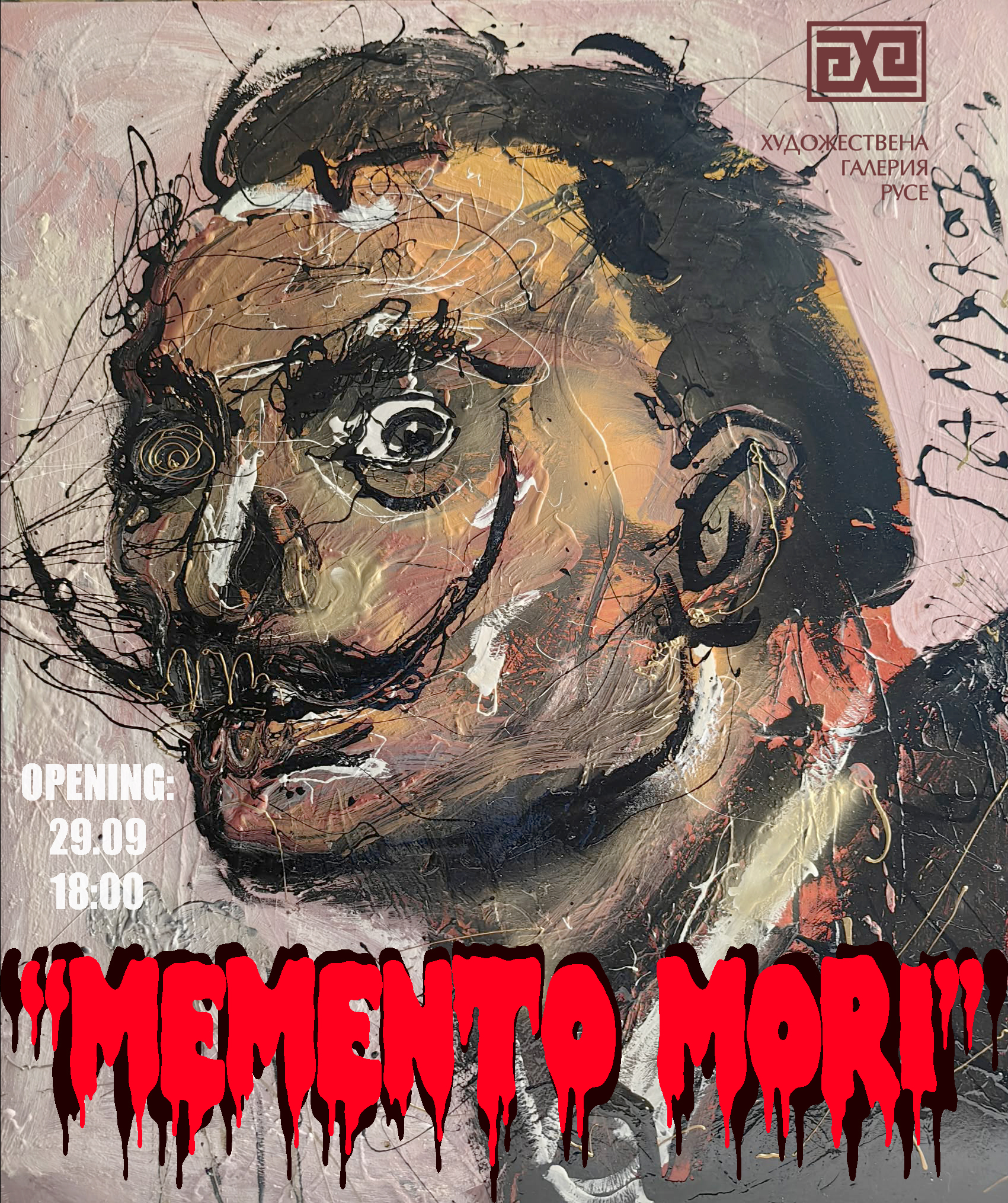
In Memento mori, the split portrait becomes a distinctive visual principle. The human image is divided, and the line running through it naturally relates to the exhibition’s central theme – transience and mortality.
Portraits based on images found on banknotes are also split, as are portraits of communist leaders. Removed from their familiar contexts and transformed through Pamukov’s expressive painterly language, these recognisable faces become part of his interpretation of memento mori.
There is one intriguing exception among them: the monkeys are the only subjects whose portraits the artist does not split. They are followed by the Neanderthal and Homo erectus. In this way, the exhibition opens a perspective backwards through time, placing the human image within a much longer history.
Animals appear in another context as well. Pigs are also part of Memento mori, accompanied by the dark humour of the artist’s observation that their lives often fit into the span “from Easter to Christmas.”
Yet the idea of time is present not only in the imagery. It can also be found in the way Pamukov works.
The artist often paints over his own earlier works. The new painting covers the previous one without completely erasing it. Fragments of the underlying layer are deliberately left visible, reminding us that another image once existed on the same surface.
This is precisely how the portrait of Salvador Dalí, chosen for the exhibition poster, was created. Beneath it lies an earlier work, Pterodactyl at Sunset, fragments of which remain visible in the new painting.
In this way, a work acquires a second life without entirely losing its first.
Pamukov describes his approach to applying paint as close to action painting. Painting becomes a physical act, involving dense accumulations of paint, lines, spills, and splashes. Traces of the artist’s gestures remain visible and sometimes extend onto the frame itself, bringing it into the pictorial field.
In Memento mori, images are divided, transformed, covered over, and brought into being again. An earlier painting may remain beneath the new one, while behind the portrait lies a reminder of its transience.
Here, “Remember that you must die” is not an ending, but a starting point for a conversation about time and what remains in its wake.