Frédéric de La Mure – COUNTRIES AND PEOPLE, 1982–2025 Ruse Art Gallery
11 September – 11 October 2026
The Embassy of France, the French Institute in Bulgaria and Sofia Press Gallery & Bookstore, in partnership with BNP Paribas S.A. – Sofia Branch, present Countries and People, 1982–2025, an exhibition by renowned French photographer Frédéric de La Mure.
The exhibition will be on view at Ruse Art Gallery, 39 Borisova Street, Ruse, from 11 September to 11 October 2026.
Curator: Olympia Daniel
Opening: Friday, 11 September 2026, at 6:30 p.m.
Presented in Sofia, Kazanlak and Ruse, the exhibition is part of the programme marking the Bicentenary of Photography, organised by the French Ministry of Culture, and the 17th European Month of Photography in Bulgaria 2026, organised by the Yanka Kyurkchieva National Association – Photo Academy.
A photographer between diplomacy and humanity
For nearly four decades, from 1982 to 2019, Frédéric de La Mure travelled the world as an official photographer of the French Ministry of Foreign Affairs. In this role, he documented diplomatic events, political encounters and the many facets of France’s presence abroad. Yet his photography has always looked beyond official protocol.
For the Bulgarian exhibition, Frédéric de La Mure and curator Olympia Daniel have selected 93 photographs that form a visual record of a changing world. More than documentary images, they act as social seismographs, registering the tensions, contradictions and human experiences of an era marked by profound geopolitical change.
Rather than remaining within the confines of diplomatic protocol, de La Mure repeatedly steps away from the official itinerary. His detours lead him towards streets, neighbourhoods and people, transforming the photographer from an observer of political events into a witness to the human reality surrounding them.
The exhibition unfolds through several interconnected themes.
It begins with a paradoxical self-portrait in which the photographer himself is absent – an image that reflects his position as an invisible witness. His presence is revealed not through his physical appearance, but through the gaze with which he observes the world and the people who inhabit it.
The theme of war and its aftermath follows. One of the exhibition’s most striking photographs was taken in Mostar in 2019. A woman crosses a street beside a wall scarred by bullets and bearing the words: “We all live under the same sky.” The photograph does not show war itself. Instead, it captures its lingering presence – the traces of violence and the way the past continues to inhabit everyday life.
Against this landscape of destruction, the exhibition places images of love, tenderness and everyday resilience. These photographs reveal moments of intimacy and ordinary life that persist despite political upheaval. Among them are portraits of children whose serious, sometimes anxious expressions seem to carry an experience far beyond their years. They are not simply witnesses to their surroundings; they appear to embody the weight and complexity of the world they have inherited.
Another dimension of de La Mure’s work emerges in the centres of political and institutional power, where documentary photography takes on an almost surreal quality.
A striking black-and-white photograph taken at Versailles shows an employee preparing the setting for a summit meeting. Dressed in ordinary work clothes, he cleans paintings surrounded by busts of historical figures. The monumental room is filled with gold, marble and dust, while the man with a cloth in his hand becomes the only truly living presence in the scene.
He is the invisible figure preparing the stage for those who will soon occupy it, while the marble rulers and generals remain silent witnesses to the passage of history. The contrast is both humorous and profound: the living man appears more enduring than the stone faces he tends to. The image quietly reminds us that grandeur is also a matter of perspective – and of maintenance.
Ultimately, Countries and People, 1982–2025 is more than a photographic chronicle of international events. It is a reflection on the relationship between the great mechanisms of history and the small, individual stories through which history is actually experienced.
The woman walking through Mostar. The worker at Versailles. The children whose eyes reveal more than words can express.
For de La Mure, these seemingly modest encounters are not peripheral to history. They are its most authentic substance.
Olympia Nikolova-Daniel
Curator
About Frédéric de La Mure
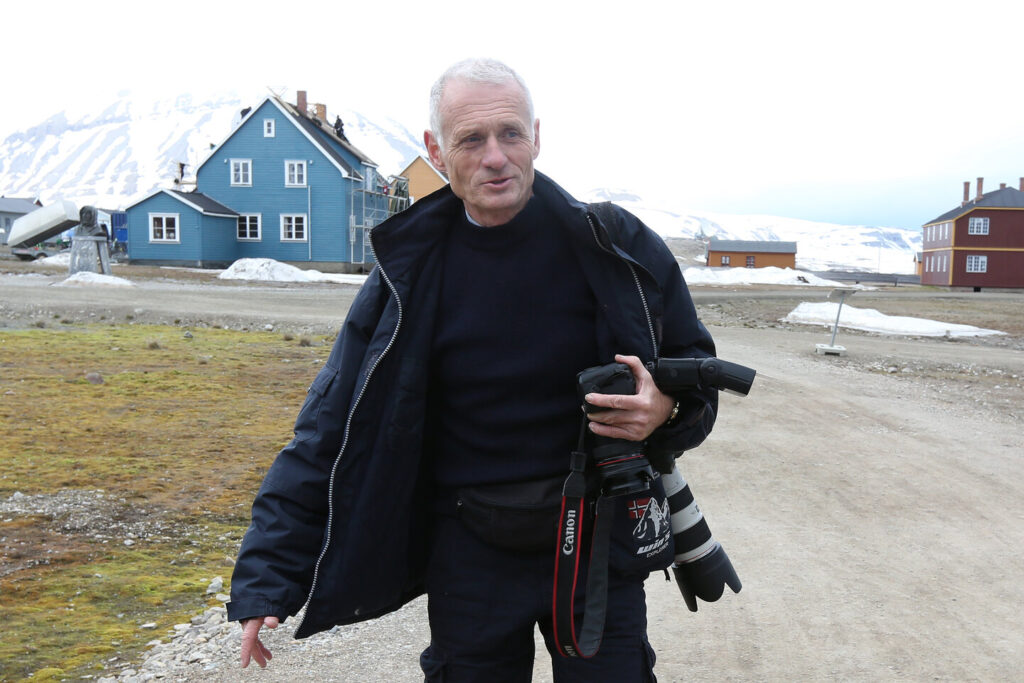
For almost 40 years, Frédéric de La Mure served as the official photographer of the French Ministry for Europe and Foreign Affairs, documenting major diplomatic events and the diverse realities of France’s presence around the world.
His career has taken him to all corners of the globe and has resulted in four books, numerous exhibitions and participation in international cultural events.
He has been awarded the titles of Knight of the National Order of Merit of the French Republic and Knight of the Legion of Honour.
Speaking about his work, de La Mure describes his approach to photography:
“For 39 years, I was the official photographer of the Ministry of Foreign Affairs. My main mission was to document the events of French diplomacy – both in Paris and in the four corners of the world.
But I have always wanted to show what lies beyond these international meetings, what happens outside the official buildings: on one side, the powerful; on the other, ordinary people. These are two faces of the same story. What is negotiated in palaces affects the lives of the people you encounter as soon as you step outside them.
I have always refused to travel like a suitcase. I like to immerse myself in the unknown, guided by chance. I walk a kilometre to the right or to the left, take any public transport line to its final stop and observe. The adventure is always just around the corner.
After leaving the Ministry of Foreign Affairs in 2019, I continued to work in the same spirit, turning my gaze towards contemporary Europe.
My photographs are never reframed. They remain within the exact boundaries of the gaze through which I captured them. You should never give yourself a ‘second chance’. To me, that would be artificial.”
Frédéric de La Mure